When the Room Wasn’t Built for You—Build Anyway Part 2: Action

In Part 1, I shared what it felt like to be the only one in the room—to question whether I belonged, even in spaces I had worked hard to enter.
I stayed quiet. I played small. Because when you’re the only one, it’s easy to believe the lie that you’re just lucky to be there. That lie settles into your bones until it feels like truth.
But awareness isn’t enough. If you want something different, you have to build it. And that starts with action.
Taking Action When It Feels Impossible
I won’t sugarcoat it—taking action when you already feel invisible, unwelcome, or unworthy is hard. Those feelings don’t go away quickly. They settle in. They start to feel normal. At times, I felt like I was pushing against a wall that wouldn’t move. And in those moments, it was easy to think: You’re the only one. This isn’t for you. Why bother trying?
But here’s what I’ve learned: It only stays impossible if you stop moving.
Looking Back to See How Far I Climbed
On paper, my path doesn’t make sense: A first-generation Vietnamese American woman with a construction management degree—who once stretched a single chicken breast across a week to survive, left a traditional career to become a yoga teacher in Europe, wrote and self-published a book, and is now a principal consultant at a global construction software company.
It’s not the story anyone expected. But that’s the point.
When I graduated university, the life I’ve built wasn’t even imaginable—because it didn’t exist yet. There was no roadmap. No defined path. Just grit, reinvention, and a refusal to let someone else write my ending.
And yet—here I am.
Like I said in Part 1: You don’t realize you’re the exception until you’ve already broken through. Until you look back and see how far you’ve climbed—despite the silence, the setbacks, and the second-guessing.
And I didn’t get here by waiting for a door to open. I built my own—brick by brick.
You don’t have to be in construction to feel like the only one in the room. These are the lessons I’ve learned while building a path no one saw coming—lessons for anyone who’s ever felt misunderstood, underestimated, or unseen.
The Four Lessons That Helped Me Build Anyway
1. Show Up and Put in the Reps
If I wanted to learn the ukulele, I had to practice. (Still working on that.) If I wanted to lead projects, I had to understand what it felt like to be on one. If I wanted to be respected in rooms that weren’t built for me, I had to keep showing up—especially when no one seemed to notice.
There’s no shortcut. No magic formula. Just discipline, repetition, and consistency.
I spent years onsite—often overlooked, often overwhelmed. But those years gave me the foundation I stand on today. I couldn’t be a consultant until I started consulting. I couldn’t push back on clients until I had walked in their shoes.
Now, after 300+ clients, I have the pattern recognition and the confidence—but I had to earn every rep.
Even when the task feels small—show up. Even when it’s hard—keep going. What feels insignificant today might become your greatest strength tomorrow.
2. Filter Out the Noise
This one took years.
Because the noise comes from everywhere—outside and in. On job sites, it sounded like catcalls. In meetings, it sounded like silence. In my head, it sounded like: You’re not good enough. You don’t belong here.
Sometimes it’s hard to tell the difference between busy work and growth. Between being overlooked… and needing more experience. Between genuine self-doubt… and a false narrative you’ve internalized.
I learned to ask myself: Is this helping me build my future—or is this just noise?
I once spent weeks counting 2.4 million bricks of refractory for a project. It felt like grunt work. A waste of time. But in hindsight, it sharpened my critical thinking and gave me a real-world understanding of how projects succeed—or fail.
It wasn’t glamorous. But it was foundational.
You don’t need everyone to believe in you. You need to believe in your direction. And remember: the noise is always loudest right before the breakthrough.
3. Speak Up—But Know Your Why
I grew up in a home where being quiet was expected. Good girls didn’t raise their voices. We waited our turn. We followed the rules.
But in my career, I learned something different: Silence doesn’t protect you. It erases you.
When I started speaking up—on job sites, in meetings, online—I heard people say:
- “I’ve dealt with that too.”
- “I’ve never thought of it that way.”
- “Thank you for saying it out loud.”
That’s when I realized: Advocating for yourself isn’t arrogance. It’s survival.
If you don’t speak up for what you’ve done, someone else might take credit. If you don’t speak up for what you believe, someone else will shape the story—and not always in your favor.
But here's the nuance: Not every silence is weakness. There’s a difference between holding back out of fear—and holding back with intention.
Sometimes silence is strategic. A pause to read the room, gather strength, or protect your peace. Other times, silence is a defense mechanism—a belief that speaking up will get you rejected or removed.
That’s where self-awareness comes in.
Are you being quiet to serve a greater purpose—or because you’ve convinced yourself you don’t deserve to be heard?
There’s a big difference between strategic silence and self-erasure.
And here’s something no one told me: Self-advocacy without self-awareness can become overcompensation.
Are you speaking up to be heard—or to prove that you belong? Are you showing up as your true self—or performing for approval?
Real growth begins when you can tell the difference.
You don’t have to speak up all the time. But when you do, speak from alignment—not desperation. That’s when people start to really listen.
4. Do It Again (and Again)
It’s easy to keep going when the path is clear. But what if you’re the first? What if you’re the only one?
When you don’t see people who look like you in the spaces you want to reach, it’s easy to assume those dreams aren’t meant for you. That failure is proof you were never meant to succeed.
But here’s the truth: Failure isn’t the end. It’s the foundation.
Straying from the expected path is scary. Especially when you’ve already “failed once” and feel like you can’t afford to do it again.
But success isn’t one big leap. It’s a series of stumbles, pivots, and small wins that start to build over time.
There’s no finish line. No perfect moment where the doubt disappears.
You’ll be rejected. You’ll fail—sometimes publicly. But failure only becomes final if you stop trying.
Resilience isn’t a single breakthrough. It’s the decision to try again. And again. And again.
I used to live in the loop: Try. Fail. Give up. Repeat. That’s when I was stuck.
Everything changed when I rewrote it: Try. Fail. Learn. Try again.
That’s when I started building the life I didn’t think I could have—but always dreamed of.
I Wasn’t Supposed to Be Here—But I Am
If I had followed the path expected of me after leaving pharmacy school, I’d be living a life that looked fine on paper—but felt hollow. A job I didn’t love. A life full of what ifs.
And to be clear—I’m not judging that path. But the real loss would’ve been never knowing what I was capable of.
In my world, people who looked like me were offered four boxes: Doctor. Pharmacist. Engineer. Nail technician.
So when I left pharmacy school, it felt like I had already failed. And when I chose construction management? The bar dropped even lower. I wasn’t just underestimated—I was expected to fail.
It wasn’t just unfamiliar. It was unimaginable.
And yet—here I am.
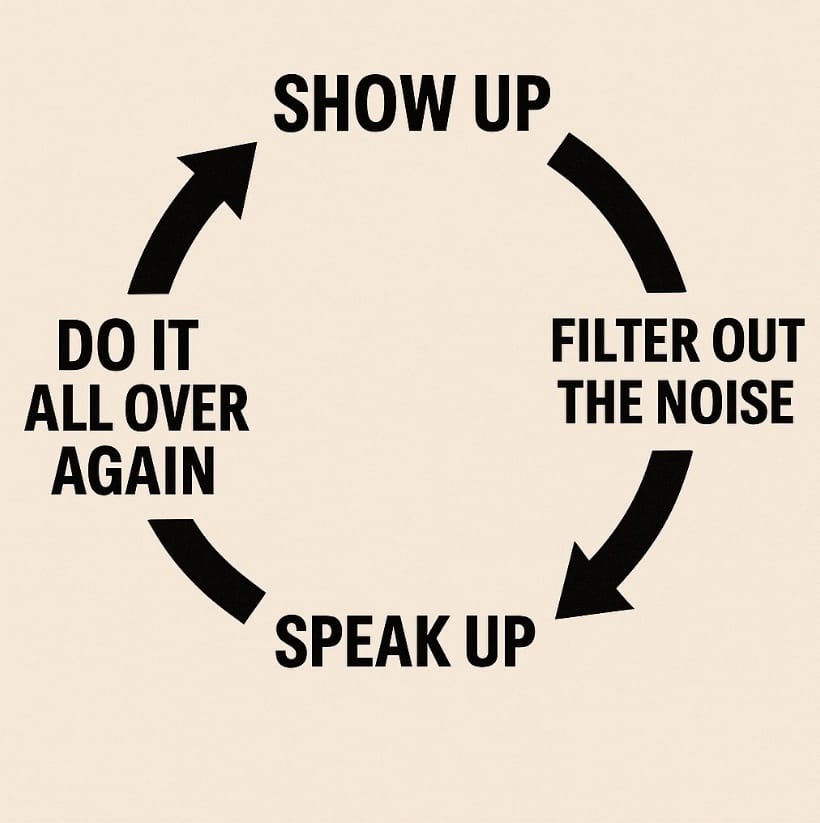
The Four Steps That Changed Everything
- Show up.
- Filter out the noise.
- Speak up.
- Do it all over again.
That cycle changed everything.
Because when the room wasn’t built for you, you have two choices:
Stay small in a space that doesn’t fit— or Start building something that does.
I chose to build. What will you do?