When Expectations Don’t Intersect with Reality
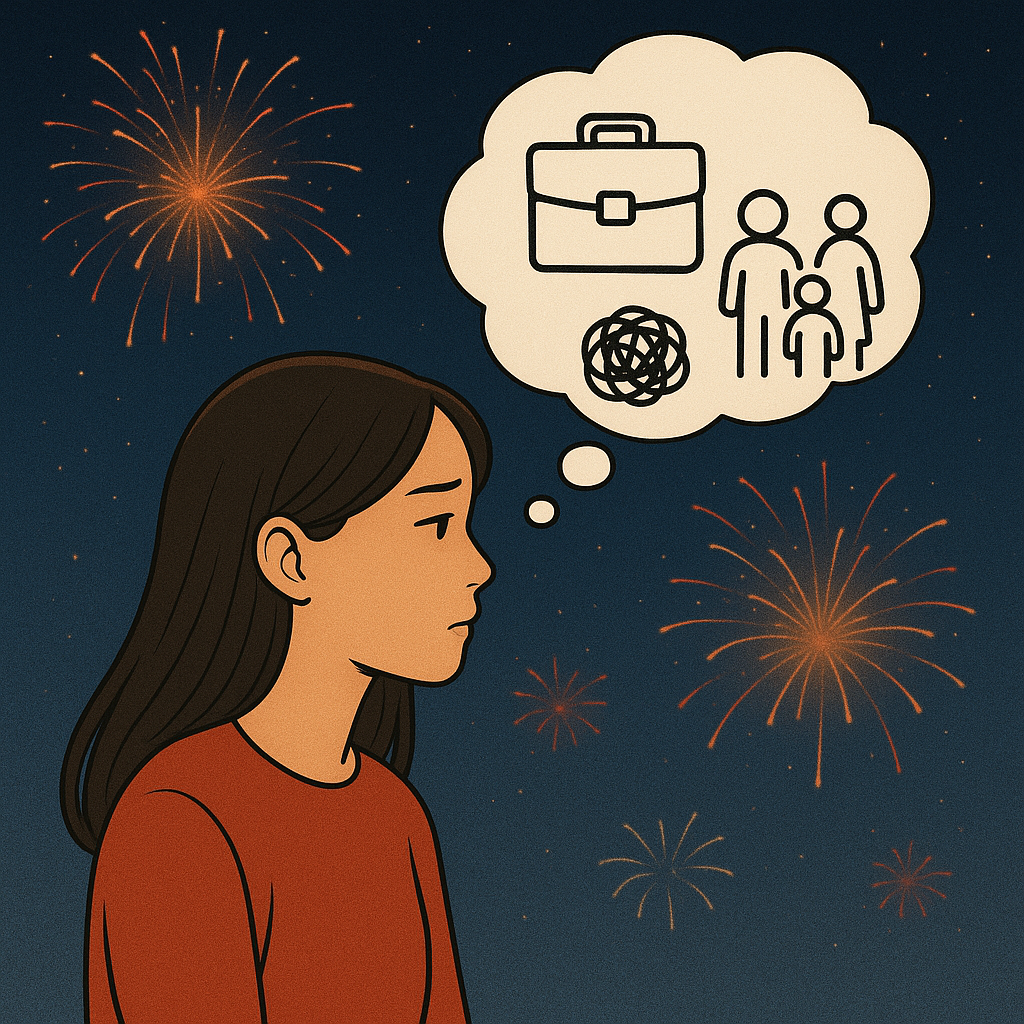
I used to think a joyous moment was something universal—something we’d all recognize when it arrived, like fireworks on New Year’s Eve or applause at the end of a performance. But I’ve learned that these moments are far more complicated than that. It’s not a moment we all celebrate in unison. It’s more like a fingerprint—deeply personal, shaped by where we come from, what we’ve survived, and what we secretly long for.
Lately, I’ve been thinking about what joy looks like in my family.
For my father, it’s a crowded dinner table—overflowing with food, noise, and people. The more dishes, the more abundance, the more love. In his world, in wartime Vietnam, food was scarce. Survival was never guaranteed. The idea that he could one day own a home in America and feed multiple generations around one table? Unimaginable.
But when I look at that same table, I see something different.
I see my mother. I see the exhaustion in her eyes as she rushes between burners, mixing ingredients, checking the oven, and forgetting what she was doing halfway through because she’s juggling too much, only for my father to say there isn’t enough food on the table. I see her sit down, finally, only to look too tired to eat. I see the mountain of uneaten leftovers. I see the labor, not the luxury.
It’s not that I don’t appreciate the tradition. It’s just that now, I see all the cracks.
Recently I wanted to offer something different. I took my family to a nice restaurant—modern Chinese cuisine, beautifully plated dishes, and a menu I had studied for days. A restaurant that has won awards. I was proud of it. I had the means, the intention, and the desire to share something new. I thought it would be a joyful memory for all of us.
Instead, when the food came, my father barely touched his food, rejecting everything that was served on his plate. My mother tried to smile but was distracted by everyone’s complaints about the forty-five minutes of traffic. I watched as the dishes remained mostly full, and no one seemed to enjoy the meal. I thought I was giving them a gift. But I was offering my version of joy, not theirs.
And for a moment, it broke me.
I had tried so hard to create an experience for them. But I was giving them my version of joy—not theirs.
That’s when I thought to myself. What did I expect to happen? Praise? Expectations don’t always intersect. In fact, they rarely do. What brings me peace or pride might never register to them as anything meaningful. What I see as an act of love—researching restaurants, treating the family to a meal—might feel wasteful or foreign to them, shaped by a different time, a different place, and different values.
One of the agreements from The Four Agreements that I return to over and over again: Don’t take anything personally.
It’s one of the hardest lessons I’ve had to learn.
It’s not personal that my father didn’t eat. Or that my mother would rather spend hours cooking than eat a dish she didn’t choose. And it’s not personal that her home-cooked meals no longer bring me comfort. In a way, it is personal—but it’s not a rejection. It wouldn’t be genuine if they forced themselves to enjoy something just to make me happy. Something that I do to them often and question myself.
But the fact is that we’re all living in different realities.
We’re all living in different realities, carrying different definitions of happiness and different standards of love. I created my life through trial, therapy, tears, and tenacity—years spent trying to break generational patterns. But when I return home, I can still feel like that same kid who never felt good enough. The one who only felt valued when she performed well, smiled on cue, or stayed quiet.
I created my life—this life—through burnout, hardship, and resilience. It wasn’t a clean path. I’ve made sacrifices. I’ve taken risks my parents could never understand. I’ve tried to forge something meaningful, not just for survival, but for fulfillment.
And yet, when I return home, I can still feel like that same little girl who never felt good enough. The one who was praised when she achieved and punished when she struggled. The one who internalized criticism and mistook it for truth. The one who felt like love was something she had to earn.
For my parents, they also created a life—built through hardship and resilience. But built on totally different circumstances. I’ll always be their kid that they will always worry about.
The older I get, the more I understand that I can’t change anyone. My parents won’t become different people because I’ve changed. They might never understand why I do what I do, or what I had to go through to become who I am. And the opposite is true. I will never understand why they did what they did, and what they had to go through to be where they are at.
I still show up. I still pay what’s asked. I help where I can. I accommodate what’s expected. But the older I get, the more I understand that I can’t change anyone. And no matter how much I grow or shift, they might never fully understand the decisions I’ve made, the boundaries I’ve drawn, or the person I’ve become.
And maybe I’ll never fully understand them either. They have so much history that they won’t ever talk about.
But that’s not the point, to learn each other's perspective. The point is that we’ve all lived through different stories. And while they may not acknowledge my perspective, I can choose to acknowledge theirs. That’s the gift of reflection: it lets us loosen our grip on resentment.
Sometimes, joyous moments feel like two trains passing each other on separate tracks. I crave connection. They crave familiarity. I look for experiences. They look for presence. We pass each other, again and again. And maybe that’s okay.
I used to tie my self-worth to whether my family understood me. I used to chase after shared moments of joy like they were proof—proof that I was good, that I was loved, that I was finally enough.
Happy moments are not one-size-fits-all. It’s not a universal destination. It’s a private map, full of detours and dead ends, that only we can read. I used to chase shared moments of joy like they were proof of something—proof that I was good enough, proof that I was loved.
Now I’m learning that some moments don’t need to be shared to be real.
And sometimes, the most profound joy is realizing that you don’t have to carry anyone else’s definition of it anymore.